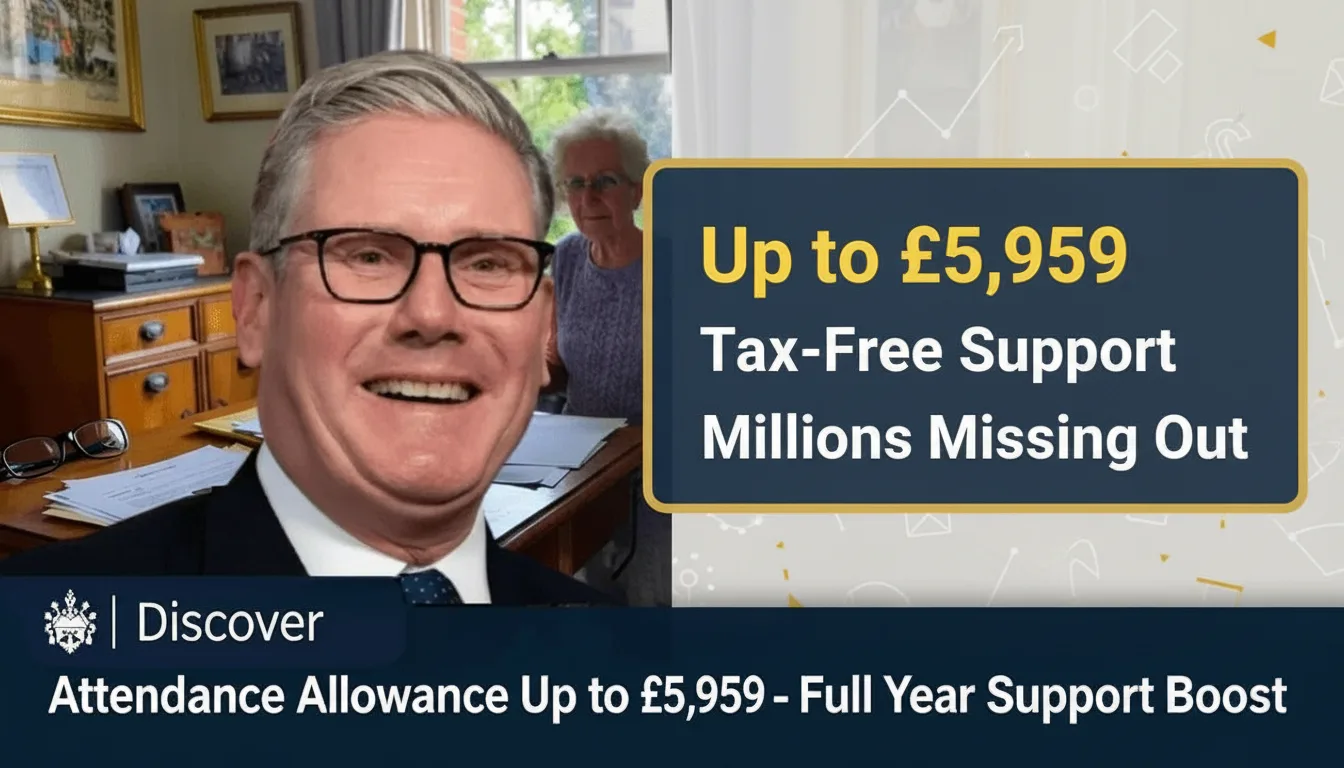
Many older people across the UK are quietly missing out on thousands of pounds they’re legally entitled to. One of the most valuable benefits on offer is Attendance Allowance, a tax-free payment that can be worth up to £5,959 in this financial year alone.
Despite its importance, countless pensioners either never apply or assume they won’t qualify. In reality, the rules are much wider than many people think, and the money can make a real difference to everyday life.
What Attendance Allowance Actually Is
Attendance Allowance is a benefit paid by the Department for Work and Pensions (DWP) to people who are over State Pension age and have a long-term illness, disability, or health condition that affects their day-to-day life.
One key point: it is not means-tested. That means your savings, income, or pension do not reduce what you receive. You can own your home outright, have money in the bank, and still qualify – the decision is based on your health needs, not your bank balance.
The benefit is also completely tax-free. It does not count as income for tax purposes, does not reduce your State Pension, and does not affect certain other payments.
For many pensioners, it’s the difference between just about coping and feeling financially secure.
What You Can Use the Money For
There are no strings attached to how you spend Attendance Allowance. Once it’s in your account, it’s yours.
People commonly use it to help with things like:
- Paying for help around the house
- Covering extra heating or electricity costs
- Funding taxis to medical appointments
- Buying aids or equipment that make daily life easier
But there are no formal restrictions. If it helps you live more comfortably or manage your condition, it’s valid.
How Much You Could Get
Attendance Allowance is paid at two different weekly rates, depending on how much help or supervision you need.
- Lower rate: £72.65 per week
- For people who need help or supervision during the day or at night.
- Higher rate: £108.55 per week
- For people who need help or supervision during the day and at night, or who are terminally ill.
Over a full financial year, that adds up to:
- More than £3,700 a year at the lower rate
- Up to £5,959 a year at the higher rate
Payments are usually made directly into your bank account every four weeks, and the benefit can run for as long as your health needs remain.
Who Can Qualify
You may be eligible for Attendance Allowance if all of the following apply:
- You are over State Pension age
- You have a long-term illness, disability, or health condition
- Your condition affects your ability to manage daily activities or means you need supervision
Daily activities cover the basics many people take for granted, such as:
- Getting dressed and undressed
- Washing or bathing
- Using the toilet
- Preparing and eating meals
- Moving around safely indoors
- Taking medication correctly
You do not need to have a paid carer, a family carer, or anyone officially looking after you to qualify. You can live alone and still claim, even if you’re managing most things yourself, as long as you need help or supervision.
It’s About How You’re Affected, Not Just the Diagnosis
Attendance Allowance is not restricted to one or two conditions. A wide range of illnesses and disabilities can qualify, including both physical and mental health issues.
The crucial point is how your condition affects your daily life, not what it’s called. Many people assume they must be severely disabled, bedbound, or housebound to qualify, but that isn’t true.
You may qualify if, for example:
- You take much longer than average to do everyday tasks
- You need someone to keep an eye on you in case you fall, get confused, or have an accident
- You need prompts or encouragement to wash, eat, or take medication
- Your condition fluctuates, but you regularly have bad days where you struggle
The DWP assessment looks at need, not how stoic or independent you try to be. People who “just get on with it” often underestimate how much help they actually require.
Backdated Payments: Why Acting Early Matters
In some cases, Attendance Allowance can be backdated to the date you first contacted the DWP to request a claim form.
That means if your claim takes a while to process and is approved, you could receive a lump sum covering the weeks or months since you first got in touch. Depending on the rate awarded and how long the decision takes, this backdated amount can run into hundreds or even thousands of pounds.
This is why it’s important to start the claim process as soon as you think you might qualify.
How Attendance Allowance Unlocks Other Help
One of the biggest hidden benefits of Attendance Allowance is that it can open the door to other financial support.
If you receive Attendance Allowance, you may become entitled to:
- Extra amounts within certain other benefits
- Higher rates of some means-tested support
- Additional help with day-to-day costs
For couples, this can be especially important. Even if only one partner receives Attendance Allowance, it can increase the household’s entitlement in other areas.
What Attendance Allowance Does Not Affect
Attendance Allowance is designed to sit alongside other support, not replace it. It:
- Is completely tax-free
- Does not reduce your State Pension
- Does not count as taxable income
It also does not affect some other forms of financial support, meaning you can keep receiving those alongside Attendance Allowance, where rules allow.
How to Start a Claim
You cannot apply for Attendance Allowance online. The system is still based on a paper claim form provided by the DWP.
You can start your claim by:
- Contacting the DWP to request an Attendance Allowance claim form
Once you ask for the form, the DWP records that date. This is crucial, because if your claim is later approved, your payments can be backdated to that original contact date, not the date you return the form.
Filling Out the Form: Why Detail Matters
The claim form is the most important part of the process, and it’s where many people miss out. A lot of claims are rejected not because the person doesn’t qualify, but because the form doesn’t clearly explain their needs.
When you fill it in, you should:
- Be honest about your worst days, not your best ones
- Describe tasks that are painful, exhausting, confusing, or unsafe
- Explain if you need reminders, encouragement, or supervision
- Mention any accidents, near misses, or times you’ve struggled alone
It’s better to over-explain than to assume something is obvious. The decision-maker isn’t watching you at home; they only see what you put on the page.
Medical evidence, such as letters from your doctor or specialist, can help, but it’s not always required. Your own detailed account of your daily difficulties carries significant weight.
How Long Decisions Take and How You’re Paid
Decisions on Attendance Allowance claims usually take around 6 to 12 weeks, though it can be quicker or slower depending on how busy the DWP is.
If your claim is approved:
- Payments are normally made directly into your bank account
- Your first payment often includes any backdated amount owed
You’ll also be told which rate you’ve been awarded and from what date it applies.
If Your Claim Is Rejected
A refusal is not necessarily the end of the road. Many people only get Attendance Allowance after challenging an initial decision.
If your claim is turned down, you have the right to:
- Ask the DWP to look at the decision again (known as a reconsideration)
- Appeal if you still disagree after that
Support organizations and local advice centers can help you understand the decision, gather better evidence, and put together a stronger case.
Why So Many People Miss Out
Despite how valuable Attendance Allowance is, it remains hugely underclaimed. Common reasons include:
- People assuming they aren’t disabled “enough”
- Not wanting to “bother” the system or appear needy
- Confusion about eligibility and the application process
- Worry that savings or income will count against them
As a result, millions of pounds go unclaimed every year – money that could significantly improve quality of life for older people who are struggling with health issues.
Why It Matters Now
With the cost of living putting pressure on household budgets, especially for those on fixed incomes, Attendance Allowance is one of the most generous and overlooked benefits available to UK pensioners.
Worth up to £5,959 this financial year at the higher rate, it can:
- Provide vital financial breathing room
- Fund practical help and support
- Boost independence and peace of mind
- Unlock access to additional benefits and top-ups
If you or someone close to you is over State Pension age and finding daily activities harder because of a long-term health condition, it is well worth exploring a claim. A successful application could transform day-to-day life — and ensure you receive money you are already legally entitled to.